Island Stories & Festival Colours
Start in Manila and explore an archipelago of more than 7,000 islands. Learn Tagalog greetings, discover adobo, lumpia, and halo-halo, and compare Cebu’s Sinulog with Lucban’s Pahiyas. The Philippines has many languages, communities, and regional traditions; one city or festival cannot represent them all.
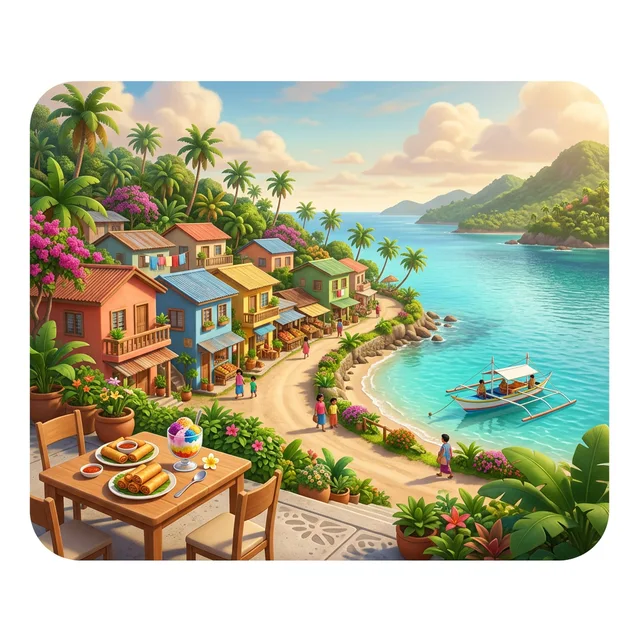
Roly’s Adventure Journal
Fictional journal entry, not a real travel account.
I could not fit every island on my page, so I drew a few dots and wrote ‘many more’. I added Manila, Cebu, and Lucban to my questions list. At our imaginary food table, I asked how each family makes a dish its own. My favourite new word was salamat: a way to say thank you.
Bobo’s island greeting rhythm
An original MaiMai greeting chant. It is not a Sinulog hymn, a traditional dance, or a ceremonial performance.
Speak each line over four gentle taps. On salamat, pause and say what you are thankful for. Learn about a festival before copying any religious gestures or costumes.
- Island stories, voices near,
- Ask a question, stop and hear.
- Salamat, a thank-you shared,
- Learn with kindness, show you cared.
Language snippets
- Tagalog: Kumusta? — How are you? Also used as a greeting
- Tagalog: Salamat — Thank you
- Tagalog: Salamat po — A polite or respectful thank you
Cultural facts
- Manila is the capital of the Philippines.
- The Philippines is an archipelago, meaning a group of islands, with more than 7,000 islands.
- Luzon, the Visayas, and Mindanao are the three main island groups.
- Filipino and English are official languages; Filipino is based on Tagalog, and many other Philippine languages are spoken.
- Adobo can describe dishes cooked with vinegar, garlic, and other seasonings; recipes vary between homes and regions.
- Lumpia are rolls with different fillings and can be served in different ways, including fresh or fried.
- Halo-halo is a dessert commonly made with shaved ice, milk, and a mixture of sweet ingredients.
- Sinulog in Cebu honours the Santo Niño, the Holy Child Jesus; its religious meaning matters alongside public celebrations.
- Pahiyas in Lucban is a harvest thanksgiving festival honouring San Isidro Labrador, associated with farmers.
- Spanish colonial rule began in the 16th century and ended in 1898; the islands already had communities, trade networks, and diverse cultures before it.
Explore by age
Ages 3–7: Islands and thank-yous
Put paper islands on a blue sheet. An archipelago has many islands, with water between them.
Use paper shapes to design an imaginary halo-halo cup, then practise salamat. If tasting real food, an adult should check ingredients and allergies.
Ages 8–12: Many islands, many communities
Find Manila, Cebu, and Lucban. Compare a harvest thanksgiving festival with a celebration honouring the Santo Niño. Traditions have meanings beyond their colours and decorations.
Make a three-column chart: place, occasion, and what people are giving thanks for. Add a question you would respectfully ask a local person.
Ages 13–18: Colonial history and cultural continuity
Spanish colonization from the 16th century to 1898 brought major changes in government, religion, and trade, alongside coercion and resistance. Its impact was not identical everywhere. Filipino communities maintained and reshaped languages and traditions; Philippine history did not begin with European arrival.
Build a timeline with three headings: before colonization, colonial rule, and independence movements. Use historical sources and distinguish people’s own accounts from a colonial official’s perspective.
Locate Philippines
Free Philippines word search and answer keys · Country facts
Sources for further reading
Source-based content; independent cultural-advisor review is not claimed.