Dublin, Knots & Storytelling
Explore Dublin, try a paper knot pattern, learn a little Gaeilge, and discover traditional music. Meet leprechauns and selkies as characters from folklore, not real creatures. Learn why St. Patrick’s Day is more than a party, while remembering that people in Ireland have many different beliefs and identities.
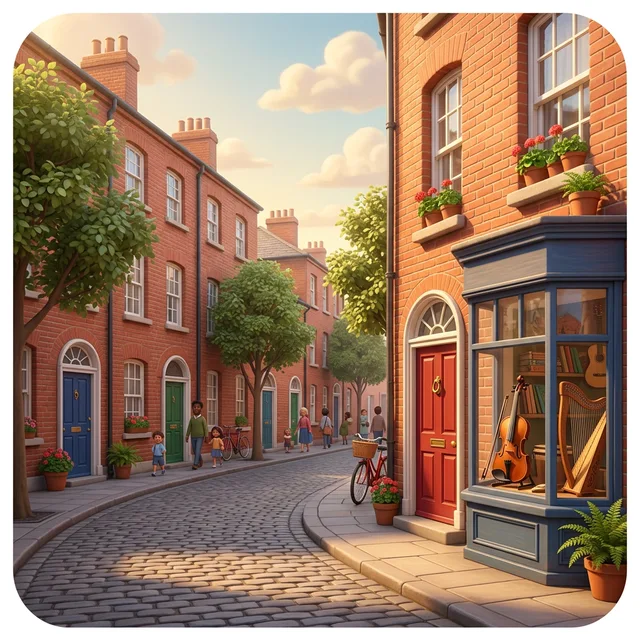
Roly’s Adventure Journal
Fictional journal entry, not a real travel account.
My first knot drawing had a loose end. I tried again and followed the line with my finger. Then I made two notebook pages: one for stories we imagine, and one for things we can check. The seal-person from our story went on the imagination page, beside a question about who first told the tale.
Bobo’s jig-counting activity
Irish traditional music includes jigs and reels. Fiddle, flute, tin whistle, harp, and bodhrán can be heard in different musical settings. This counting exercise is original, not a traditional tune.
Count ONE-two-three FOUR-five-six while tapping gently. Try two groups of three. Listen respectfully to a musician’s performance through the Irish Traditional Music Archive; no audio is embedded here.
- ONE two three, FOUR five six,
- Tap a gentle pattern, not a trick.
- Listen first, then find your beat,
- Keep it soft with hands or feet.
Language snippets
- Irish (Gaeilge): Dia duit — Hello to one person; literally a blessing, ‘God be with you’
- Irish (Gaeilge): Go raibh maith agat — Thank you to one person
- Irish (Gaeilge): Slán — Goodbye
Cultural facts
- Dublin is the capital of Ireland.
- The island of Ireland contains Ireland and Northern Ireland; Northern Ireland is part of the United Kingdom.
- Irish is called Gaeilge in Irish. It is a different language from Scottish Gaelic.
- Irish is the first official language of Ireland under the Constitution; English is also an official language.
- St. Patrick’s Day falls on March 17 and has a history as a Christian feast day.
- Modern St. Patrick’s Day celebrations also reflect Irish communities and their descendants around the world.
- Leprechauns are figures in folklore, not real people or a description of Irish people.
- Selkie stories describe seals that can take human form; these tales belong to folklore in Ireland and Scotland.
- Interlaced knot patterns appear in medieval art, including decorated manuscripts; not every knot has one agreed ancient meaning.
- The harp is an Irish national symbol. Irish traditional music also includes instruments such as the fiddle and tin whistle.
Explore by age
Ages 3–7: Stories and winding lines
Draw a line that loops over and under itself. Tell a gentle make-believe story about a seal, clearly saying it is imagined.
Wave hello, try a goodbye, and tap along to a slow count with an adult. No special costume is needed.
Ages 8–12: History or legend?
St. Patrick’s Day remembers a Christian saint and has changed over time. Legends about Patrick are not all historical evidence. Folklore is valuable as storytelling even when its events are not factual.
Make three labels: checked fact, legend, and question. Sort statements from this adventure. Compare a jig’s two groups of three beats with a steady four-beat count.
Ages 13–18: Language, identity, and evidence
Explore how language revival, migration, religion, and political history shape Irish identity. Do not assume everyone on the island shares a nationality or religious belief. Distinguish a medieval artwork from a modern claim about what its knot means.
Read the museum’s account of St. Patrick’s Day. Identify one tradition that changed over time and one question that would need another source.
Locate Ireland
Free Ireland word search and answer keys · Country facts
Sources for further reading
Source-based content; independent cultural-advisor review is not claimed.